Prolegomena · Text of the first edition, 1687 · pp. 12–26
Axiomata, sive Leges Motus
Axioms, or Laws of Motion
Latin complete · fully annotated
Headnote
Three sentences, six corollaries and a scholium. Newton calls them axiomata: starting points that are not proved but are, as the Scholium puts it, "received by mathematicians and confirmed by abundant experience." Almost nothing in them was wholly new. Galileo had something like Law I, Descartes stated rectilinear inertia clearly, and Wren, Wallis and Huygens had found the collision rules behind Law III. What was new is that Newton made them a complete and sufficient basis: with these laws plus a force law, everything in the next 500 pages follows by mathematics. Read the corollaries closely. The parallelogram of forces (Corol. I–II), conservation of momentum (III), the free motion of the centre of mass (IV) and the relativity of uniform motion (V) are where the laws begin to be used.
Sentence by sentence 144 Latin sentences on this page, each paired with one English sentence. Select a Latin sentence and its English comes alongside; select an English sentence and the page brings the Latin to the centre, then the English follows. Arrow keys step, Esc clears. Where the 1687 page sets a word apart (roman in italic text, italic in roman text), the English sets its counterpart apart too; hover either to light the other.
AXIOMATA
SIVE
LEGES MOTUS
AXIOMS,
OR
LAWS OF MOTION
Axioms, or Laws of Motion
The gist, in plain English
Axioms, or Laws of Motion.
Words
- axiomata
- axioms: starting propositions accepted without proof (Euclid’s word)
- leges motus
- laws of motion: lex also suggests a law laid down by a lawgiver
Lex. I.
Corpus omne perseverare in statu suo quiescendi vel movendi uniformiter in directum, nisi quatenus a viribus impressis cogitur statum illum mutare.
Projectilia perseverant in motibus suis nisi quatenus a resistentia aeris retardantur & vi gravitatis impelluntur deorsum. Trochus, cujus partes cohærendo perpetuo retrahunt sese a motibus rectilineis, non cessat rotari nisi quatenus ab aere retardatur. Majora autem Planetarum & Cometarum corpora motus suos & progressivos & circulares in spatiis minus resistentibus factos conservant diutius.
Law I.
Every body perseveres in its state of resting or of moving uniformly straight forward, except in so far as it is compelled by impressed forces to change that state.
Projectiles persevere in their motions except in so far as they are slowed by the resistance of the air and driven downward by the force of gravity. A top, whose parts by cohering continually draw one another back from straight-line motions, does not stop spinning except in so far as it is slowed by the air. And the larger bodies of the planets and comets keep their motions, both progressive and circular, made in spaces that resist less, for a longer time.
Law I · Inertia
The gist, in plain English
Every body perseveres in its state of resting or of moving uniformly straight ahead, except insofar as it is compelled by impressed forces to change that state. Projectiles keep on in their motions except as the air’s resistance slows them and gravity drives them downward. A spinning top, whose parts by their cohesion keep pulling one another away from straight-line motion, does not stop turning except as the air slows it. The larger bodies of planets and comets keep their forward and circular motions, made in less resisting spaces, for a longer time.
Words
- perseverare
- to persist, continue (infinitive: the law is reported speech, [dico] corpus omne perseverare)
- in statu suo
- “in its state”: rest or uniform motion count as states, not processes
- nisi quatenus
- “except insofar as”
- trochus
- a top (child’s spinning toy)
- cohærendo
- “by cohering”, holding together
Commentary
What it overturns. For an Aristotelian, motion needs a mover and rest is natural. Law I puts uniform straight motion in the same class as rest: both are states that need no cause. Only changes of state need a cause, and that cause is called force (Def. IV).
Why the examples? None of them is a clean case. Projectiles curve and slow; tops eventually stop. Newton is teaching the reader to see each deviation from the ideal as the work of an identifiable force (air, gravity, cohesion), so that the ideal becomes a tool. The planets are the best example because space resists so little.
Modern statement. In an inertial frame,
Logically Law I looks like a special case of Law II. Its real work is to define the frames in which Law II holds: those in which free bodies move uniformly in straight lines. That ties it to the absolute space of the previous Scholium.
Lex. II.
Mutationem motus proportionalem esse vi motrici impressæ, & fieri secundum lineam rectam qua vis illa imprimitur.
Si vis aliqua motum quemvis generet, dupla duplum, tripla triplum generabit, sive simul & semel, sive gradatim & successive impressa fuerit. Et hic motus quoniam in eandem semper plagam cum vi generatrice determinatur, si corpus antea movebatur, motui ejus vel conspiranti additur, vel contrario subducitur, vel obliquo oblique adjicitur, & cum eo secundum utriusq; determinationem componitur.
Law II.
A change of motion is proportional to the motive force impressed, and takes place along the straight line in which that force is impressed.
If some force generates any motion, double the force will generate double the motion, and triple the force triple, whether it was impressed all at once or gradually and successively. And since this motion is always directed the same way as the generating force, if the body was already moving, the new motion is added to its motion if the two agree, subtracted if they are opposed, or joined obliquely if they are oblique, and is compounded with it according to the direction of each.
Law II · Force and change of motion
The gist, in plain English
The change of motion is proportional to the motive force impressed, and takes place along the straight line in which that force is impressed. If some force generates any motion, double the force will generate double the motion and triple the force triple, whether it is impressed all at once or gradually and in succession. And since this motion always points the same way as the generating force, if the body was already moving, the new motion is added to the old if they agree, subtracted if they are opposed, or joined obliquely if oblique, and compounded with it according to the directions of both.
Words
- mutatio motus
- “change of motion”: change of momentum (Def. II)
- vis motrix impressa
- impressed motive force
- simul & semel
- “all at once” (as in a blow)
- gradatim & successive
- “gradually and successively” (as in steady pressure)
- plaga
- direction, region (literally a tract of sky)
- conspiranti … contrario … obliquo
- agreeing in direction … opposite … slanting
Commentary
Not quite F = ma. Newton writes "change of motion," not "rate of change," and he explicitly covers both an impulse given "all at once" and a force applied "gradually." His Law II is about impulse:
and when the force acts continuously he takes it as a limit of many small impulses. The differential form
was written down by later mathematicians, notably Euler in 1750. All the reasoning in the Principia is consistent with it: in Book I, Prop. I, Newton literally builds a continuous force out of a series of blows.
Direction is part of the law. "Along the straight line in which that force is impressed" and the closing clause (add, subtract, or compound obliquely) make force and change of motion directed quantities, combining by the parallelogram rule, as Corollary I will show.
What it does not say. There is no constant of proportionality. Newton works with ratios throughout ("double the force, double the motion"), in the style of Euclid’s theory of proportion. Units and the constant arrived much later.
Lex. III.
Actioni contrariam semper & æqualem esse reactionem: sive corporum duorum actiones in se mutuo semper esse æquales & in partes contrarias dirigi.
Quicquid premit vel trahit alterum, tantundem ab eo premitur vel trahitur. Siquis lapidem digito premit, premitur & hujus digitus a lapide. Si equus lapidem funi allegatum trahit, retrahetur etiam & equus æqualiter in lapidem: nam funis utrinq; distentus eodem relaxandi se conatu urgebit Equum versus lapidem, ac lapidem versus equum, tantumq; impediet progressum unius quantum promovet progressum alterius. Si corpus aliquod in corpus aliud impingens, motum ejus vi sua quomodocunq; mutaverit, idem quoque vicissim in motu proprio eandem mutationem in partem contrariam vi alterius (ob æqualitatem pressionis mutuæ) subibit. His actionibus æquales fiunt mutationes non velocitatum sed motuum, (scilicet in corporibus non aliunde impeditis:) Mutationes enim velocitatum, in contrarias itidem partes factæ, quia motus æqualiter mutantur, sunt corporibus reciproce proportionales.
Law III.
To every action there is always an opposite and equal reaction: or, the actions of two bodies on each other are always equal and directed to opposite parts.
Whatever presses or pulls another is pressed or pulled by it just as much. If anyone presses a stone with a finger, the finger is also pressed by the stone. If a horse pulls a stone tied to a rope, the horse too will be pulled back equally towards the stone: for the rope, stretched at both ends, will by the same endeavour to slacken itself urge the horse towards the stone and the stone towards the horse, and will hinder the progress of the one as much as it furthers the progress of the other. If some body, striking another body, changes that body’s motion in any way by its own force, it will in turn undergo, by the force of the other, the same change in its own motion, towards the opposite part (because the mutual pressure is equal). By these actions equal changes are made, not of velocities but of motions (that is, in bodies not hindered by anything else); for the changes of velocities, made likewise towards opposite parts, are inversely proportional to the bodies, because the motions are changed equally.
Law III · Action and reaction
The gist, in plain English
To every action there is always an equal and contrary reaction; or, the actions of two bodies on each other are always equal and directed to opposite parts. Whatever presses or pulls another is pressed or pulled just as much by it. Press a stone with your finger and the stone presses your finger. If a horse pulls a stone tied to a rope, the horse is pulled back equally toward the stone: the rope, stretched both ways, urges the horse toward the stone and the stone toward the horse with the same effort to slacken, and hinders the one’s progress as much as it furthers the other’s. If one body striking another changes its motion in any way, it will itself undergo the same change of its own motion in the opposite direction, because the mutual pressure is equal. By these actions equal changes are made, not of velocities but of motions (in bodies not hindered by anything else). The changes of velocity, also in opposite directions, are inversely as the bodies, since the motions change equally.
Words
- reactio
- reaction: a rare word before Newton; he makes it technical
- funis allegatus
- a rope tied (to it)
- utrinq; distentus
- “stretched on both sides”
- eodem relaxandi se conatu
- “with the same endeavour to relax itself”
- tantundem
- “just as much”
- reciproce proportionales
- “inversely proportional”
Commentary
The puzzle of the horse. If the rope pulls back on the horse exactly as hard as the horse pulls the stone, how does anything move? Newton answers in the gloss: the rope's equal pulls act on different bodies. Whether the horse advances depends on all the forces on the horse, including the ground pushing on its hooves. Law III pairs forces across bodies; Law II sums forces on a single body. Students still trip on this distinction.
Equal motions, unequal velocities. The last sentence holds the quantitative content:
A cannon recoils slowly and the ball flies fast. Their motions change equally and oppositely.
The bold part comes later. For pushes and collisions Law III was well tested (see the Scholium). Newton applies it to gravitation at a distance as well: the Earth pulls the Moon, so the Moon pulls the Earth equally; the Sun pulls Jupiter, so Jupiter pulls the Sun. In Book III that symmetry turns "the planets are attracted to the Sun" into "every particle attracts every other," the step from celestial mechanics to universal gravitation.
Corol. I.
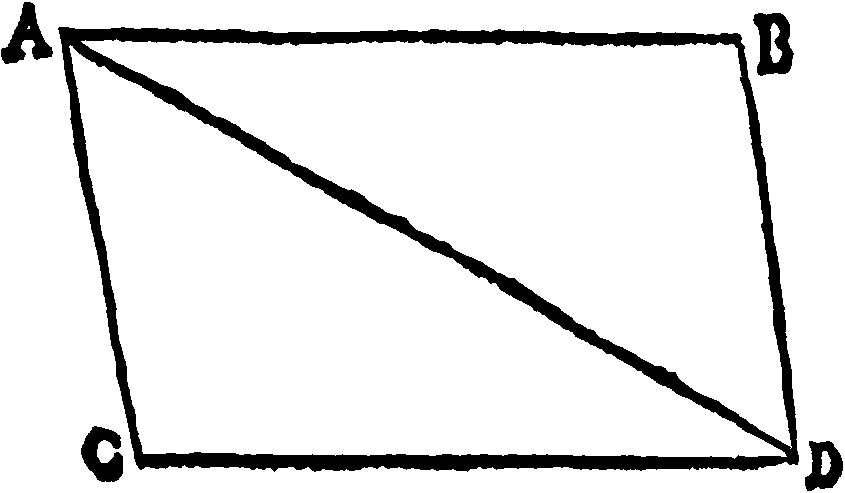
Corpus viribus conjunctis diagonalem parallelogrammi eodem tempore describere, quo latera separatis.
Si corpus dato tempore, vi sola M, ferretur ab A ad B, & vi sola N, ab A ad C, compleatur parallelogrammum ABDC, & vi utraq; feretur id eodem tempore ab A ad D. Nam quoniam vis N agit secundum lineam AC ipsi BD parallelam, hæc vis nihil mutabit velocitatem accedendi ad lineam illam BD a vi altera genitam. Accedet igitur corpus eodem tempore ad lineam BD sive vis N imprimatur, sive non, atq; adeo in fine illius temporis reperietur alicubi in linea illa BD. Eodem argumento in fine temporis ejusdem reperietur alicubi in linea CD, & idcirco in utriusq; lineæ concursu D reperiri necesse est.
Corollary I.
A body acted on by forces jointly describes the diagonal of a parallelogram in the same time in which it would describe the sides under the forces separately.
If in a given time a body would be carried by the force M alone from A to B, and by the force N alone from A to C, complete the parallelogram ABDC, and by both forces together it will be carried in the same time from A to D. For since the force N acts along the line AC, parallel to BD, this force will in no way change the velocity of approach to that line BD generated by the other force. The body will therefore approach the line BD in the same time whether the force N is impressed or not, and so at the end of that time it will be found somewhere on that line BD. By the same argument, at the end of the same time it will be found somewhere on the line CD, and therefore it must be found at D, where the two lines meet.
Corollary I · The parallelogram of forces
The gist, in plain English
A body acted on by two forces jointly describes the diagonal of a parallelogram in the same time as it would describe the sides under the forces separately. If in a given time the force alone would carry the body from to , and the force alone from to , complete the parallelogram ; under both forces it goes in the same time from to . Since force acts along , parallel to , it does not change the speed with which the body approaches the line , which the other force produced. So the body reaches in the same time whether acts or not, and at the end of that time it is somewhere on . By the same argument it is somewhere on , so it must be at their intersection .
Words
- viribus conjunctis
- “with the forces joined”
- diagonalis
- diagonal (of a parallelogram)
- compleatur parallelogrammum
- “let the parallelogram be completed”
- velocitas accedendi
- “the speed of approaching”
- in utriusq; lineæ concursu
- “at the meeting of each line”, at the intersection
Commentary
The concrete problem. Two influences act on one body at the same time. Does each do its own work, and how do the results combine? Newton’s argument is clever because it uses no algebra. A force along is parallel to , so it cannot change how fast the body closes on the line . Each force is "blind" to the motion it does not push along. The body is then trapped on two lines at once, and they meet at one point.
Modern statement. Displacements (and impulses) add as vectors:
That is the independence of forces, or the superposition principle, and every proposition in the book silently relies on it. Note that Newton treats the forces as instantaneous impulses ("in a given time … from to " uniformly). Continuous forces are again handled as limits.
Corol. II.
Et hinc patet compositio vis directæ AD ex viribus quibusvis obliquis AB & BD, & vicissim resolutio vis cujusvis directæ AD in obliquas quascunq; AB & BD. Quæ quidem Compositio & resolutio abunde confirmatur ex Mechanica.
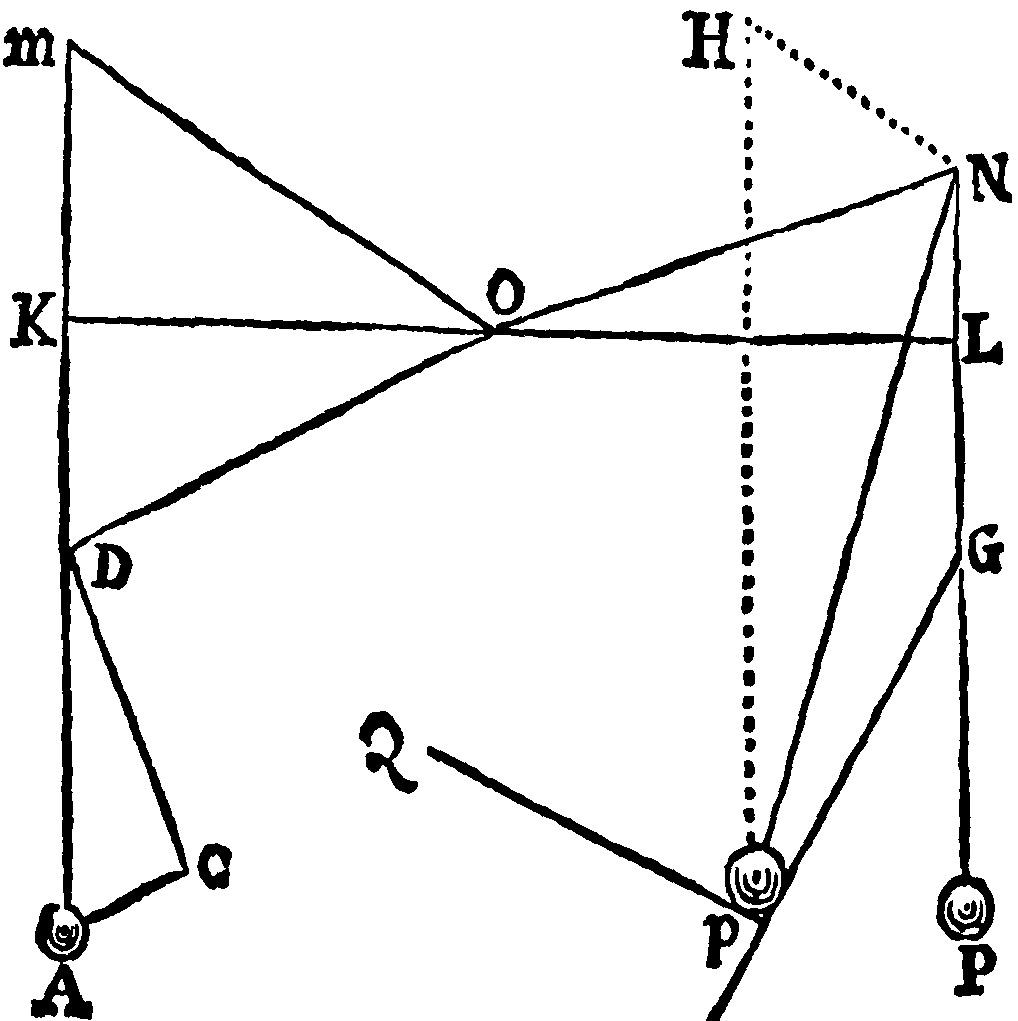
Ut si de rotæ alicujus centro O exeuntes radij inæquales OM, ON filis MA, NP sustineant pondera A & P, & quærantur vires ponderum ad movendam rotam: per centrum O agatur recta KOL filis perpendiculariter occurrens in K & L, centroq; O & intervallorum OK, OL majore OL describatur circulus occurrens filo MA in D: & actæ rectæ OD parallela sit AC & perpendicularis DC. Quoniam nihil refert utrum filorum puncta K, L, D affixa sint vel non affixa ad planum rotæ, pondera idem valebunt ac si suspenderentur a punctis K & L vel D & L. Ponderis autem A exponatur vis tota per lineam AD, & hæc resolvetur in vires AC, CD, quarum AC trahendo radium OD directe a centro nihil valet ad movendam rotam; vis autem altera DC, trahendo radium DO perpendiculariter, idem valet ac si perpendiculariter traheret radium OL ipsi OD æqualem; hoc est idem atq; pondus P, quod sit ad pondus A ut vis DC ad vim DA, id est (ob similia triangula ADC, DOK,) ut OK ad OD seu OL. Pondera igitur A & P, quæ sunt reciproce ut radii in directum positi OK & OL, idem pollebunt & sic consistent in æquilibrio: (quæ est proprietas notissima Libræ, Vectis & Axis in Peritrochio:) sin pondus alterutrum sit majus quam in hac ratione, erit vis ejus ad movendam rotam tanto major.
Quod si pondus p ponderi P æquale partim suspendatur filo Np, partim incumbat plano obliquo pG: agantur pH, NH, prior horizonti, posterior plano pG perpendicularis; & si vis ponderis p deorsum tendens, exponatur per lineam pH, resolvi potest hæc in vires pN, HN. Si filo pN perpendiculare esset planum aliquod pQ secans planum alterum pG in linea ad horizontem parallela; & pondus p his planis pQ, pG solummodo incumberet; urgeret illud hæc plana viribus pN, HN perpendiculariter, nimirum planum pQ vi pN & planum pG vi HN. Ideoque si tollatur planum pQ ut pondus tendat filum, quoniam filum sustinendo pondus, jam vicem præstat plani sublati, tendetur illud eadem vi pN, qua planum antea urgebatur. Unde tensio fili hujus obliqui erit ad tensionem fili alterius perpendicularis PN, ut pN ad pH. Ideoq; si pondus p sit ad pondus A in ratione quæ componitur ex ratione reciproca minimarum distantiarum filorum suorum AM, pN a centro rotæ, & ratione directa pH ad pN; pondera idem valebunt ad rotam movendam, atq; adeo se mutuo sustinebunt, ut quilibet experiri potest.
Pondus autem p planis illis duobus obliquis incumbens, rationem habet cunei inter corporis fissi facies internas: & inde vires cunei & mallei innotescunt: utpote cum vis qua pondus p urget planum pQ sit ad vim, qua idem vel gravitate sua vel ictu mallei impellitur secundum lineam pH in plano, ut pN ad pH; atq; ad vim qua urget planum alterum pG ut pN ad NH. Sed & vis Cochleæ per similem virium divisionem colligitur; quippe quæ cuneus est a vecte impulsus. Usus igitur Corollarij hujus latissime patet, & late patendo veritatem ejus evincit, cum pendeat ex jam dictis Mechanica tota ab Authoribus diversimode demonstrata. Ex hisce enim facile derivantur vires Machinarum, quæ ex Rotis, Tympanis, Trochleis, Vectibus, radijs volubilibus, nervis tensis & ponderibus directe vel oblique ascendentibus, cæterisq; potentijs Mechanicis componi solent, ut & vires Nervorum ad animalium ossa movenda.
Corollary II.
And hence is evident the composition of a direct force AD out of any oblique forces AB and BD, and, conversely, the resolution of any direct force AD into any oblique forces AB and BD. And this composition and resolution is abundantly confirmed from mechanics.
For example, if unequal radii OM and ON, going out from the centre O of some wheel, hold up the weights A and P by the cords MA and NP, and the forces of the weights to move the wheel are sought: through the centre O draw the straight line KOL meeting the cords perpendicularly at K and L; with centre O and the greater, OL, of the distances OK and OL, describe a circle meeting the cord MA at D; and let AC be drawn parallel to the straight line OD, and DC perpendicular to it. Since it makes no difference whether the points K, L, D of the cords are fixed to the plane of the wheel or not, the weights will have the same effect as if they hung from the points K and L, or D and L. Now let the whole force of the weight A be represented by the line AD; it will be resolved into the forces AC and CD, of which AC, pulling the radius OD straight away from the centre, does nothing to move the wheel; but the other force, DC, pulling the radius DO perpendicularly, has the same effect as if it pulled perpendicularly on the radius OL, equal to OD; that is, the same effect as the weight P, if that weight is to the weight A as the force DC to the force DA, that is (because the triangles ADC and DOK are similar) as OK to OD or OL. The weights A and P, then, which are inversely as the radii OK and OL lying in one straight line, will have equal power and so will stand in equilibrium (which is the well-known property of the balance, the lever, and the wheel and axle); but if either weight is greater than in this ratio, its force to move the wheel will be so much the greater.
But if a weight p, equal to the weight P, partly hangs from the cord Np and partly rests on the inclined plane pG, draw pH and NH, the first perpendicular to the horizon, the second to the plane pG; and if the downward force of the weight p is represented by the line pH, it can be resolved into the forces pN and HN. If there were some plane pQ perpendicular to the cord pN, cutting the other plane pG in a line parallel to the horizon, and the weight p rested only on these planes pQ and pG, it would press on these planes perpendicularly with the forces pN and HN: on the plane pQ with the force pN, and on the plane pG with the force HN. And so, if the plane pQ is taken away so that the weight stretches the cord, then, since the cord, by holding up the weight, now does the work of the plane removed, it will be stretched by the same force pN with which the plane was pressed before. Hence the tension of this oblique cord will be to the tension of the other, perpendicular cord PN as pN to pH. And so, if the weight p is to the weight A in the ratio compounded of the inverse ratio of the least distances of their cords, AM and pN, from the centre of the wheel and the direct ratio of pH to pN, the weights will have the same power to move the wheel, and so will hold each other up, as anyone can test by experiment.
Now the weight p, resting on those two inclined planes, acts like a wedge between the inner faces of a split body; and from this the forces of the wedge and the mallet become known, since the force with which the weight p presses on the plane pQ is to the force with which it is driven along the line pH in the plane, either by its own gravity or by the blow of a mallet, as pN to pH; and to the force with which it presses on the other plane pG as pN to NH. The force of the screw, too, is found by a similar division of forces, since a screw is a wedge driven by a lever. The use of this corollary, then, extends very widely, and by extending so widely it proves its truth, since the whole of mechanics, demonstrated in different ways by different authors, depends on what has just been said. For from these are easily derived the forces of machines, which are usually built from wheels, drums, pulleys, levers, turning spokes, stretched strings, weights rising straight up or obliquely, and the other mechanical powers; and also the forces of the sinews that move the bones of animals.
Corollary II · Composition and resolution; the machines
The gist, in plain English
From this the composition of a direct force out of any oblique forces and is plain, and conversely the resolution of any direct force into any oblique ones and . Mechanics abundantly confirms this. Take a wheel with centre and unequal spokes , holding weights and by threads. To find the forces of the weights for turning the wheel, draw through perpendicular to the threads. A weight acts just as if hung from the point where its thread meets this perpendicular, so the weights balance when they are inversely as the distances , : the well-known property of the balance, the lever and the wheel-and-axle. Resolving the pull of a thread slanting at into a part along the radius (which does nothing) and a part perpendicular to it (which turns the wheel) reduces the oblique case to the straight one. Resolving a weight that rests partly on an inclined plane and partly hangs from a thread explains the inclined plane; a weight wedged between two planes is the wedge, and the screw is a wedge driven by a lever. So this corollary reaches very widely and proves its truth by its reach, since all of mechanics depends on it: the forces of machines made of wheels, drums, pulleys, levers, cords and weights, and even the forces of the sinews that move the bones of animals.
Words
- compositio … resolutio
- composition (adding forces) … resolution (splitting a force into components)
- radij inæquales
- unequal spokes
- libra
- a balance (pair of scales)
- vectis
- a lever
- planum obliquum
- an inclined plane
- cuneus
- a wedge
- cochlea
- a screw
- trochlea
- pulley
- Axis in Peritrochio
- the wheel and axle (windlass)
- nervi
- sinews, tendons (not “nerves”)
Commentary
Why a book on planets talks about wheels. Corollary I is a claim about motion. The engineers’ simple machines are about equilibrium. Newton shows that one rule, resolving a force into perpendicular parts and keeping only the part that acts, gives the law of the lever, the balance, the inclined plane, the wedge and the screw. Statics becomes a corollary of dynamics. A reader in 1687 trusted the lever, so showing that the new laws reproduce it is a way of earning trust.
The lever in modern dress. For a force applied at distance from an axis at angle to the radius, only turns the wheel, so equilibrium is equality of torques:
Newton’s construction (drop the perpendicular , take the "effective" lever arms , ) is the geometric way to compute .
Corol. III.
Quantitas motus quæ colligitur capiendo summam motuum factorum ad eandem partem, & differentiam factorum ad contrarias, non mutatur ab actione corporum inter se.
Etenim actio eiq; contraria reactio æquales sunt per Legem 3, adeoq; per legem 2, æquales in motibus efficiunt mutationes versus contrarias partes. Ergo si motus fiunt ad eandem partem, quicquid additur motui corporis fugientis subducetur motui corporis insequentis sic, ut summa maneat eadem quæ prius. Sin corpora obviam eant, æqualis erit subductio de motu utriusq;, adeoq; differentia motuum factorum in contrarias partes manebit eadem.
Ut si corpus sphæricum A sit triplo majus corpore sphærico B, habeatq; duas velocitatis partes, et B sequatur in eadem recta cum velocitatis partibus decem, adeoq; motus ipsius A sit ad motum ipsius B ut sex ad decem; ponantur motus illis esse partium sex & decem, & summa erit partium sexdecim. In corporum igitur concursu, si corpus A lucretur motus partes tres vel quatuor vel quinq; corpus B amittet partes totidem, adeoq; perget corpus A post reflexionem cum partibus novem vel decem vel undecim; & B cum partibus septem vel sex vel quinq; existente semper summa partium sexdecim ut prius. Sin corpus A lucretur partes novem vel decem vel undecim vel duodecim, adeoq; progrediatur post concursum cum partibus quindecim vel sexdecim vel septendecim vel octodecim; corpus B amittendo, tot partes quot A lucratur, vel progredietur cum una parte, amissis partibus novem, vel quiescet amisso motu suo progressivo partium decem, vel regredietur cum una parte amisso motu suo & (ut ita dicam) una parte amplius, vel regredietur cum partibus duabus ob detractum motum progressivum partium duodecim. Atq; ita summæ motuum conspirantium 15 + 1 vel 16 + 0, differentiæ contrariorum 17 - 1 & 18 - 2 semper erunt partium sexdecim ut ante concursum & reflexionem. Cognitis autem motibus quibuscum corpora post reflexionem pergent, invenietur cujusq; velocitas ponendo eam esse ad velocitatem ante reflexionem ut motus post ad motum ante. Ut in casu ultimo, ubi corporis A motus erat partium sex ante reflexionem; partium octodecim postea, & velocitas partium duarum ante reflexionem; invenietur ejus velocitas partium sex post reflexionem, dicendo, ut motus partes sex ante reflexionem ad motus partes octodecim postea, ita velocitatis partes duæ ante reflexionem ad velocitatis partes sex postea.
Quod si corpora vel non Sphærica vel diversis in rectis moventia incidant in se mutuo oblique, & requirantur eorum motus post reflexionem, cognoscendus est situs plani a quo corpora concurrentia tanguntur in puncto concursus; dein corporis utriusq; motus (per Corol. 2.) distinguendus est in duos, unum huic plano perpendicularem, alterum eidem parallelum: motus autem paralleli, propterea quod corpora agant in se invicem secundum lineam huic plano perpendicularem, retinendi sunt iidem post reflexionem atq; antea, & motibus perpendicularibus mutationes æquales in partes contrarias tribuendæ sunt sic, ut summa conspirantium & differentia contrariorum maneat eadem quæ prius. Ex hujusmodi reflexionibus oriri etiam solent motus circulares corporum circa centra propria. Sed hos casus in sequentibus non considero, & nimis longum esset omnia huc spectantia demonstrare.
Corollary III.
The quantity of motion, which is found by taking the sum of the motions made towards the same part and the difference of those made towards opposite parts, is not changed by the action of bodies on one another.
For an action and the reaction opposite to it are equal by Law 3, and so, by Law 2, they produce equal changes in the motions, towards opposite parts. So if the motions are towards the same part, whatever is added to the motion of the body in front will be taken from the motion of the body following, so that the sum stays the same as before. But if the bodies meet head on, an equal amount will be taken from the motion of each, and so the difference of the motions made towards opposite parts will stay the same.
For example, if a spherical body A is three times as large as a spherical body B and has two parts of velocity, and B follows in the same straight line with ten parts of velocity, so that the motion of A is to the motion of B as six to ten, suppose their motions to be of six parts and ten parts, and the sum will be sixteen parts. In the collision of the bodies, then, if the body A gains three or four or five parts of motion, the body B will lose as many, and so after the rebound A will go on with nine or ten or eleven parts, and B with seven or six or five, the sum always being sixteen parts as before. But if the body A gains nine or ten or eleven or twelve parts, and so goes on after the collision with fifteen or sixteen or seventeen or eighteen parts, then the body B, losing as many parts as A gains, will either go on with one part, having lost nine, or come to rest, having lost its forward motion of ten parts, or go back with one part, having lost its motion and (so to speak) one part more, or go back with two parts, because a forward motion of twelve parts has been taken from it. And so the sums of the motions in the same direction, 15 + 1 or 16 + 0, and the differences of the opposite ones, 17 − 1 and 18 − 2, will always be sixteen parts, as before the collision and rebound. And when the motions with which the bodies go on after the rebound are known, the velocity of each will be found by taking it to be to the velocity before the rebound as the motion after is to the motion before. As in the last case, where the motion of the body A was six parts before the rebound and eighteen parts after, and its velocity two parts before the rebound, its velocity after the rebound will be found to be six parts, by saying: as six parts of motion before the rebound are to eighteen parts of motion after, so are two parts of velocity before the rebound to six parts of velocity after.
But if bodies that are either not spherical, or moving in different straight lines, strike each other obliquely, and their motions after the rebound are sought, one must know the position of the plane that touches the colliding bodies at the point of collision; then the motion of each body must be split (by Corol. 2) into two, one perpendicular to this plane and the other parallel to it; the parallel motions, since the bodies act on each other along a line perpendicular to this plane, are to be kept the same after the rebound as before, and equal changes towards opposite parts are to be given to the perpendicular motions, so that the sum of those in the same direction and the difference of the opposite ones stay the same as before. Rebounds of this kind also commonly give rise to circular motions of bodies about their own centres. But I do not consider these cases in what follows, and it would take too long to demonstrate everything that bears on them.
Corollary III · Conservation of momentum
The gist, in plain English
The quantity of motion, found by adding the motions in one direction and subtracting those in the opposite direction, is not changed by the action of bodies on one another. Action and reaction are equal (Law III), so by Law II they make equal changes of motion in opposite directions. If the bodies move the same way, whatever is added to the one fleeing is taken from the one pursuing, and the sum stays the same; if they meet head on, an equal amount is taken from each, and the difference stays the same. Example: sphere three times the size of sphere , moving with 2 parts of velocity and following on the same line with 10, so the motions are 6 and 10 and the sum is 16. Whatever gains in the collision, loses: may go on with 9, 10 or 11 and with 7, 6 or 5; or if gains 12, goes on with 18 and comes back with 2. In every case 15 + 1, 16 + 0, 17 − 1, 18 − 2 still make sixteen. From the motions, the velocities follow by dividing by the bodies. The same holds in oblique collisions, if the motions are resolved along the line of impact.
Words
- summa … differentia
- sum (same direction) … difference (opposite directions): Newton’s way of handling signs
- corpus fugiens … insequens
- the body fleeing (in front) … the one pursuing (behind)
- obviam eant
- “go to meet each other”, collide head-on
- lucretur … amittet
- “gains … will lose”
- ut ita dicam
- “so to speak”
Commentary
The concrete problem. Two balls collide. You cannot see the forces during the impact: they are huge, brief and unknown. Can you still say anything certain about the outcome? Yes. Whatever the forces are, Law III makes them equal and opposite at every instant, so their effects on momentum cancel in the total.
The example, checked. has mass 3 and speed 2, so motion 6; has mass 1 and speed 10, so motion 10; total 16. Newton then lists outcomes. All of them conserve momentum, but they are not all physically possible: the ones where ends up faster than behind it would require the bodies to pass through each other. Momentum alone does not fix the result. You also need the elasticity, which is why the Scholium measures how strongly balls of wool, steel, cork and glass rebound. Newton is careful: conservation is a constraint, not the whole solution.
Signs without negative numbers. "Sum of conspiring, difference of contrary" is how a seventeenth-century writer handled vector components along a line before signed quantities were routine. "Regredietur cum una parte" is our .
Corol. IIII.
Commune gravitatis centrum ab actionibus corporum inter se non mutat statum suum vel motus vel quietis, & propterea corporum omnium in se mutuo agentium (exclusis actionibus & impedimentis externis) commune centrum gravitatis vel quiescit vel movetur uniformiter in directum.
Nam si puncta duo progrediantur uniformi cum motu in lineis rectis & distantia eorum dividatur in ratione data, punctum dividens vel quiescet vel progredietur uniformiter in linea recta. Hoc postea in Lemmate xxiii demonstratur in plano, & eadem ratione demonstrari potest in loco solido. Ergo si corpora quotcunq; moventur uniformiter in lineis rectis, commune centrum gravitatis duorum quorumvis, vel quiescit vel progreditur uniformiter in linea recta, propterea quod linea horum corporum centra in rectis uniformiter progredientia jungens, dividitur ab hoc centro communi in ratione data: similiter & commune centrum horum duorum & tertii cujusvis vel quiescit vel progreditur uniformiter in linea recta, propterea quod ab eo dividitur distantia centri communis corporum duorum & centri corporis tertii in data ratione. Eodem modo & commune centrum horum trium & quarti cujusvis vel quiescit vel progreditur uniformiter in linea recta, propterea quod ab eo dividitur distantia inter centrum commune trium & centrum quarti in data ratione, & sic in infinitum. Igitur in systemate corporum quæ actionibus in se invicem, alijsq; omnibus in se extrinsecus impressis, omnino vacant, adeoq; moventur singula uniformiter in rectis singulis, commune omnium centrum gravitatis vel quiescit vel movetur uniformiter in directum.
Porro in systemate duorum corporum in se invicem agentium, cum distantiæ centrorum utriusq; a communi gravitatis centro sint reciproce ut corpora, erunt motus relativi corporum eorundem vel accedendi ad centrum illud vel ab eodem recedendi, æquales inter se. Proinde centrum illud a motuum æqualibus mutationibus in partes contrarias factis, atq; adeo ab actionibus horum corporum inter se, nec promovetur nec retardatur nec mutationem patitur in statu suo quoad motum vel quietem. In systemate autem corporum plurium, quoniam duorum quorumvis in se mutuo agentium commune gravitatis centrum ob actionem illam nullatenus mutat statum suum; & reliquorum, quibuscum actio illa non intercedit, commune gravitatis centrum nihil inde patitur; distantia autem horum duorum centrorum dividitur, a communi corporum omnium centro, in partes summis totalibus corporum, quorum sunt centra, reciproce proportionales, adeoq; centris illis duobus statum suum movendi vel quiescendi servantibus, commune omnium centrum servat etiam statum suum; manifestum est quod commune illud omnium centrum, ob actiones binorum corporum inter se, nunquam mutat statum suum quoad motum & quietem. In tali autem systemate actiones omnes corporum inter se, vel inter bina sunt corpora, vel ab actionibus inter bina compositæ, & propterea communi omnium centro mutationem in statu motus ejus vel Quietis nunquam inducunt. Quare cum centrum illud ubi corpora non agunt in se invicem, vel quiescit, vel in recta aliqua progreditur uniformiter, perget idem, non obstantibus corporum actionibus inter se, vel semper quiescere, vel semper progredi uniformiter in directum, nisi a viribus in systema extrinsecus impressis deturbetur de hoc statu. Est igitur systematis corporum plurium Lex eadem quæ corporis solitarii, quoad perseverantiam in statu motus vel quietis. Motus enim progressivus seu corporis solitarii seu systematis corporum ex motu centri gravitatis æstimari semper debet.
Corollary IV.
The common centre of gravity does not change its state, either of motion or of rest, through the actions of bodies on one another; and therefore the common centre of gravity of all bodies acting on one another (external actions and hindrances excluded) is either at rest or moves uniformly straight forward.
For if two points move forward with uniform motion in straight lines, and the distance between them is divided in a given ratio, the dividing point will either be at rest or move forward uniformly in a straight line. This is proved later, in Lemma xxiii, for the plane, and it can be proved in the same way for solid space. So if any number of bodies move uniformly in straight lines, the common centre of gravity of any two of them is either at rest or moves forward uniformly in a straight line, because the line joining the centres of these bodies, which move forward uniformly in straight lines, is divided by this common centre in a given ratio; similarly the common centre of these two and any third body is either at rest or moves forward uniformly in a straight line, because it divides in a given ratio the distance between the common centre of the two bodies and the centre of the third. In the same way the common centre of these three and any fourth is either at rest or moves forward uniformly in a straight line, because it divides in a given ratio the distance between the common centre of the three and the centre of the fourth; and so on without end. Therefore, in a system of bodies that are wholly free of actions on one another and of all other actions impressed on them from outside, and so each move uniformly in its own straight line, the common centre of gravity of them all is either at rest or moves uniformly straight forward.
Further, in a system of two bodies acting on each other, since the distances of their centres from the common centre of gravity are inversely as the bodies, the relative motions of these bodies, whether of approaching that centre or of receding from it, will be equal to each other. So that centre is neither pushed forward nor held back, nor does it undergo any change in its state as to motion or rest, through equal changes of the motions made towards opposite parts, and so through the actions of these bodies on each other. But in a system of several bodies, since the common centre of gravity of any two acting on each other in no way changes its state because of that action, and the common centre of gravity of the rest, with which that action has nothing to do, is not affected by it at all, while the distance between these two centres is divided by the common centre of all the bodies into parts inversely proportional to the total sums of the bodies whose centres they are, and so, since those two centres keep their state of moving or resting, the common centre of all keeps its state too: it is clear that this common centre of all never changes its state as to motion and rest because of the actions of pairs of bodies on each other. And in such a system all the actions of the bodies on one another are either between pairs of bodies or compounded of actions between pairs, and therefore they never bring about any change in the state of motion or rest of the common centre of all. So since that centre, when the bodies do not act on one another, is either at rest or moves forward uniformly in some straight line, it will, in spite of the actions of the bodies on one another, go on either always at rest or always moving forward uniformly straight on, unless it is driven out of this state by forces impressed on the system from outside. The law for a system of several bodies, then, is the same as for a single body, as regards persevering in a state of motion or of rest. For the forward motion, whether of a single body or of a system of bodies, must always be reckoned from the motion of the centre of gravity.
Corollary IV · The centre of gravity moves uniformly
The gist, in plain English
The common centre of gravity of two or more bodies does not change its state of motion or rest through the actions of the bodies on one another; and so the common centre of gravity of all bodies acting on one another (excluding external actions and hindrances) either rests or moves uniformly in a straight line. If two points move uniformly in straight lines and the distance between them is divided in a given ratio, the dividing point either rests or moves uniformly in a straight line (proved later in Lemma XXIII for the plane, and the same holds in space). So if the bodies move freely, the centre of any two, and therefore of all, moves uniformly. When the bodies act on each other, two bodies acting on each other receive equal and opposite changes of motion, so their common centre is not disturbed, and by stepping from pairs to the whole system the centre of the whole continues uniformly. Hence a system of bodies obeys Law I as a single body does, both for progressive motion and for rest.
Words
- commune gravitatis centrum
- the common centre of gravity: our centre of mass
- exclusis actionibus & impedimentis externis
- “external actions and hindrances excluded” (ablative absolute)
- in loco solido
- “in solid space”, in three dimensions
- quotcunq;
- “however many”
Commentary
Why this matters for astronomy. Is the Sun at rest? Newton’s answer in Book III (Prop. XII in later editions) is: not exactly. The Sun and the planets pull on each other, so the Sun wobbles about the common centre of gravity of the solar system, and it is that point which rests or moves uniformly. Corollary IV makes this precise. Internal forces, however violent, cannot accelerate the centre of mass.
Modern form. With and ,
So with no external force, is constant. Newton does the same cancellation pair by pair, without summation signs. The reference to Lemma XXIII is to the 1687 numbering. That lemma, on points moving uniformly in straight lines, sits in Book I, Section V.
Corol. V.
Corporum dato spatio inclusorum ijdem sunt motus inter se, sive spatium illud quiescat, sive moveatur idem uniformiter in directum absq; motu circulari.
Nam differentiæ motuum tendentium ad eandem partem, & summæ tendentium ad contrarias, eadem sunt sub initio in utroq; casu (ex hypothesi) & ex his summis vel differentiis oriuntur congressus & impetus quibus corpora se mutuo feriunt. Ergo per Legem 2 æquales erunt congressuum effectus in utroq; casu, & propterea manebunt motus inter se in uno casu æquales motibus inter se in altero. Idem comprobatur experimento luculento. Motus omnes eodem modo se habent in Navi, sive ea quiescat, sive moveatur uniformiter in directum.
Corollary V.
The motions of bodies enclosed in a given space are the same among themselves whether that space is at rest or moves uniformly straight forward without circular motion.
For the differences of the motions tending towards the same part, and the sums of those tending towards opposite parts, are the same at the beginning in both cases (by hypothesis), and from these sums or differences arise the collisions and impulses with which the bodies strike one another. So by Law 2 the effects of the collisions will be equal in both cases, and therefore the motions among themselves in the one case will remain equal to the motions among themselves in the other. The same is confirmed by a clear experiment. All motions behave in the same way in a ship, whether it is at rest or moves uniformly straight forward.
Corollary V · Relativity of uniform motion
The gist, in plain English
The motions of bodies enclosed in a given space are the same among themselves whether that space is at rest or moves uniformly in a straight line without circular motion. The differences of motions in the same direction, and the sums of those in opposite directions, are the same at the start in either case (by hypothesis), and from these the collisions and impulses arise. So by Law II the effects of the collisions are equal in both cases, and the motions among themselves stay the same. A clear experiment proves it: all motions behave the same way in a ship whether it is at rest or moving uniformly in a straight line.
Words
- dato spatio inclusorum
- “shut up in a given space”
- absq; motu circulari
- “without circular motion”: rotation is excluded
- experimentum luculentum
- “a bright, clear experiment”
- Navis
- a ship
Commentary
The tension with the Scholium. A few pages earlier Newton insisted on absolute space and absolute motion. Here he proves that uniform motion through absolute space can never be detected from inside. The ship in calm water was Galileo’s image in the Dialogue (1632). So absolute velocity is real for Newton but has no observable effect. Only absolute rotation (excluded here with absque motu circulari) and acceleration have effects. Newton saw the tension. Later physics resolved it by dropping absolute rest and keeping the class of inertial frames.
Modern form: Galilean invariance. Under with constant , accelerations are unchanged, , and so are forces that depend on relative positions and velocities, so
Einstein kept the principle (special relativity) and changed the transformation.
Corol. VI.
Si corpora moveantur quomodocunq; inter se & a viribus acceleratricibus æqualibus secundum lineas parallelas urgeantur; pergent omnia eodem modo moveri inter se ac si viribus illis non essent incitata.
Nam vires illæ æqualiter (pro quantitatibus movendorum corporum) & secundum lineas parallelas agendo, corpora omnia æqualiter (quoad velocitatem) movebunt (per Legem 2.) adeoq; nunquam mutabunt positiones & motus eorum inter se.
Corollary VI.
If bodies move in any way among themselves and are urged by equal accelerative forces along parallel lines, they will all go on moving among themselves in the same way as if they had not been driven by those forces.
For those forces, acting equally (in proportion to the quantities of the bodies to be moved) and along parallel lines, will move all the bodies equally (as to velocity), by Law 2, and so will never change their positions and motions among themselves.
Corollary VI · A common acceleration is invisible
The gist, in plain English
If bodies move in any way among themselves and are urged by equal accelerative forces along parallel lines, they will all go on moving among themselves as if those forces were not acting. The forces, acting equally (in proportion to the bodies moved) and along parallel lines, will move all the bodies equally as far as velocity goes (by Law II), and so will never change their positions and motions relative to one another.
Words
- viribus acceleratricibus æqualibus
- “by equal accelerative forces” (Def. VII): equal accelerations, not equal pushes
- secundum lineas parallelas
- “along parallel lines”
- incitata
- “set in motion, urged on”
Commentary
This short corollary does a great deal of work in Book III. Jupiter and its moons all fall toward the Sun with (nearly) the same acceleration, because they are at nearly the same distance. By Corollary VI that common fall has no effect on how the moons move around Jupiter, so the Jovian system can be analysed as if the Sun were absent. The same goes for the Earth–Moon system. Only the difference in the Sun’s pull, the tidal part, disturbs the Moon, and Newton later computes exactly that.
Einstein called a closely related observation (in a freely falling elevator you cannot feel the common acceleration) "the happiest thought of my life." Newton states the uniform-field case here as a two-line corollary.
Scholium
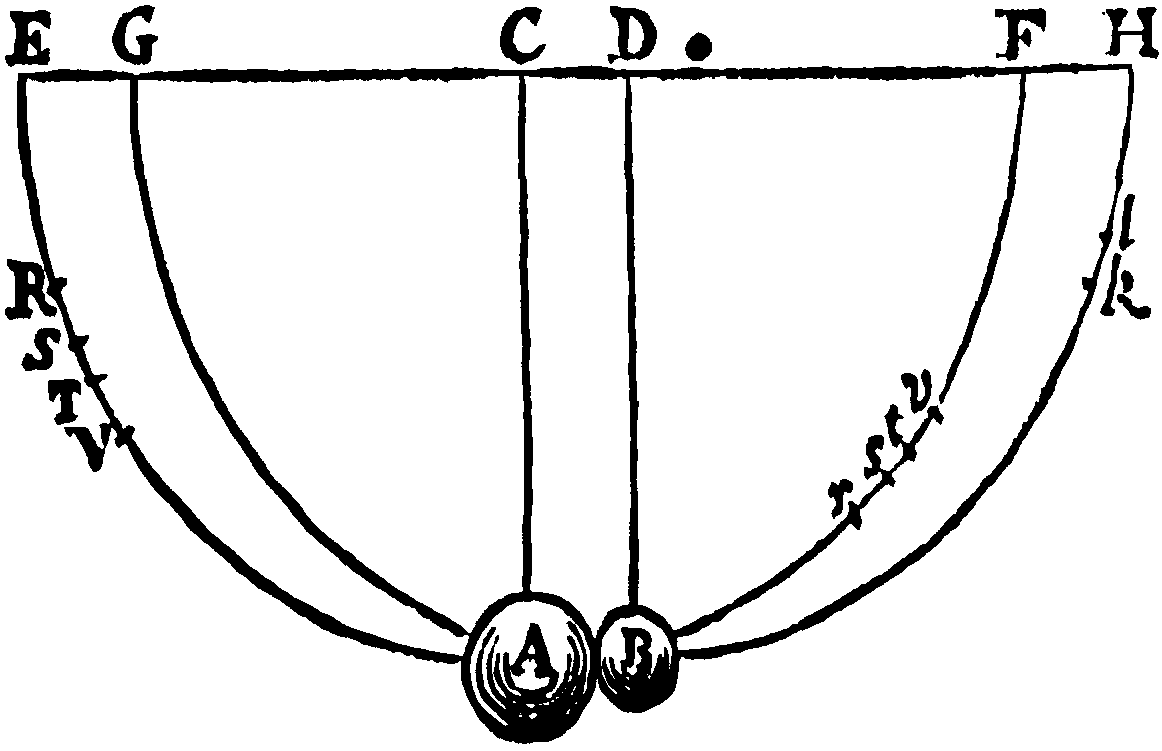
Hactenus principia tradidi a Mathematicis recepta & experientia multiplici confirmata. Per leges duas primas & Corollaria duo prima adinvenit Galilæus descensum gravium esse in duplicata ratione temporis, & motum projectilium fieri in Parabola, conspirante experientia, nisi quatenus motus illi per aeris resistentiam aliquantulum retardantur. Ab ijsdem Legibus & Corollariis pendent demonstrata de temporibus oscillantium Pendulorum, suffragante Horologiorum experientia quotidiana. Ex his ijsdem & Lege tertia D. Christopherus Wrennus Eques auratus, Johannes Wallisius S.T.D. & D. Christianus Hugenius, hujus ætatis Geometrarum facile Principes, regulas congressuum & reflexionum duorum corporum seorsim adinvenerunt, & eodem fere tempore cum Societate Regia communicarunt, inter se (quoad has leges) omnino conspirantes; Et primus quidem D. Wallisius dein D. Wrennus & D. Hugenius inventum prodidit. Sed & veritas comprobata est a D. Wrenno coram Regia Societate per experimentum Pendulorum, quod etiam Clarissimus Mariottus Libro integro exponere mox dignatus est. Verum ut hoc experimentum cum Theorijs ad amussim congruat, habenda est ratio tum resistentiæ aeris, tum etiam vis Elasticæ concurrentium corporum. Pendeant corpora A, B filis parallelis AC, BD a centris C, D. His centris & intervallis describantur semicirculi EAF, GBH radijs CA, DB bisecti. Trahatur corpus A ad arcus EAF punctum quodvis R, & (subducto corpore B) demittatur inde, redeatq; post unam oscillationem ad punctum V. Est RV retardatio ex resistentia aeris. Hujus RV fiat ST pars quarta sita in medio, & hæc exhibebit retardationem in descensu ab S ad A quam proxime. Restituatur corpus B in locum suum. Cadat corpus A de puncto S, & velocitas ejus in loco reflexionis A, absq; errore sensibili, tanta erit ac si in vacuo cecidisset de loco T. Exponatur igitur hæc velocitas per chordam arcus TA. Nam velocitatem Penduli in puncto infimo esse ut chorda arcus quem cadendo descripsit, Propositio est Geometris notissima. Post reflexionem perveniat corpus A ad locum s, & corpus B ad locum k. Tollatur corpus B & inveniatur locus v, a quo si corpus A demittatur & post unam oscillationem redeat ad locum r, sit st pars quarta ipsius rv sita in medio, & per chordam arcus tA exponatur velocitas quam corpus A proxime post reflexionem habuit in loco A. Nam t erit locus ille verus & correctus ad quem corpus A, sublata aeris resistentia, ascendere debuisset. Simili methodo corrigendus erit locus k, ad quem corpus B ascendit, & inveniendus locus l, ad quem corpus illud ascendere debuisset in vacuo. Hoc pacto experiri licet omnia perinde ac si in vacuo constituti essemus. Tandem ducendum erit corpus A in chordam arcus TA (quæ velocitatem ejus exhibet) ut habeatur motus ejus in loco A proxime ante reflexionem, deinde in chordam arcus tA ut habeatur motus ejus in loco A proxime post reflexionem. Et sic corpus B ducendum erit in chordam arcus Bl, ut habeatur motus ejus proxime post reflexionem. Et simili methodo ubi corpora duo simul demittuntur de locis diversis, inveniendi sunt motus utriusq; tam ante, quam post reflexionem; & tum demum conferendi sunt motus inter se & colligendi effectus reflexionis. Hoc modo in Pendulis pedum decem rem tentando, idq; in corporibus tam inæqualibus quam æqualibus, & faciendo ut corpora de intervallis amplissimis, puta pedum octo, duodecim vel sexdecim concurrerent, reperi semper sine errore trium digitorum in mensuris, ubi corpora sibi mutuo directe occurrebant quod in partes contrarias mutatio motus erat corpori utriq; illata, atq; adeo quod actio & reactio semper erant æquales. Ut si corpus A incidebat in corpus B cum novem partibus motus, & amissis septem partibus pergebat post reflexionem cum duabus, corpus B resiliebat cum partibus istis septem. Si corpora obviam ibant, A cum duodecim partibus & B cum sex & redibat A cum duabus, redibat B cum octo, facta detractione partium quatuordecim utrinque. De motu ipsius A subducantur partes duodecim & restabit nihil; subducantur aliæ partes duæ & fiet motus duarum partium in plagam contrariam. & sic de motu corporis B partium sex subducendo partes quatuordecim, fiunt partes octo in plagam contrariam. Quod si corpora ibant ad eandem plagam, A velocius cum partibus quatuordecim & B tardius cum partibus quinq; & post reflexionem pergebat A cum quinq; partibus, pergebat B cum quatuordecim, facta translatione partium novem de A in B. Et sic in reliquis. A congressu & collisione corporum nunquam mutabatur quantitas motus quæ ex summa motuum conspirantium & differentia contrariorum colligebatur. Namq; errorem digiti unius & alterius in mensuris tribuerim difficultati peragendi singula satis accurate. Difficile erat tum pendula simul demittere sic, ut corpora in se mutuo impingerent in loco infimo AB, tum loca s, k, notare ad quæ corpora ascendebant post concursum. Sed & in ipsis pilis inæqualis partium densitas, & textura aliis de causis irregularis, errores inducebant.
Porro nequis objiciat Regulam ad quam probandam inventum est hoc experimentum præsupponere corpora vel absolute dura esse, vel saltem perfecte elastica, cujusmodi nulla reperiuntur in compositionibus naturalibus; addo quod experimenta jam descripta succedunt in corporibus mollibus æque ac in duris, nimirum a conditione duritiei neutiquam pendentia. Nam si conditio illa in corporibus non perfecte duris tentanda est, debebit solummodo reflexio minui in certa proportione pro quantitate vis Elasticæ. In Theoria Wrenni & Hugenij corpora absolute dura redeunt ab invicem cum velocitate congressus. Certius id affirmabitur de perfecte Elasticis. In imperfecte Elasticis velocitas reditus minuenda est simul cum vi Elastica; propterea quod vis illa, (nisi ubi partes corporum ex congressu læduntur, vel extensionem aliqualem quasi sub malleo patiuntur,) certa ac determinata sit (quantum sentio) faciatq; corpora redire ab invicem cum velocitate relativa quæ sit ad relativam velocitatem concursus in data ratione. Id in pilis ex lana arcte conglomerata & fortiter constricta sic tentavi. Primum demittendo Pendula & mensurando reflexionem, inveni quantitatem vis Elasticæ; deinde per hanc vim determinavi reflexiones in aliis casibus concursuum, & respondebant experimenta. Redibant semper pilæ ab invicem cum velocitate relativa, quæ esset ad velocitatem relativam concursus ut 5 ad 9 circiter. Eadem fere cum velocitate redibant pilæ ex chalybe: aliæ ex subere cum paulo minore. In vitreis autem proportio erat 15 ad 16 circiter. Atq; hoc pacto Lex tertia quoad ictus & reflexiones per Theoriam comprobata est, quæ cum experientia plane congruit.
In attractionibus rem sic breviter ostendo. Corporibus duobus quibusvis A, B se mutuo trahentibus, concipe obstaculum quodvis interponi quo congressus eorum impediatur. Si corpus alterutrum A magis trahitur versus corpus alterum B, quam illud alterum B in prius A, obstaculum magis urgebitur pressione corporis A quam pressione corporis B; proindeq; non manebit in æquilibrio. Prævalebit pressio fortior, facietq; systema corporum duorum & obstaculi moveri in directum in partes versus B, motuq; in spatiis liberis semper accelerato abire in infinitum. Quod est absurdum & Legi primæ contrarium. Nam per Legem primam debebit systema perseverare in statu suo quiescendi vel movendi uniformiter in directum, proindeq; corpora æqualiter urgebunt obstaculum, & idcirco æqualiter trahentur in invicem. Tentavi hoc in Magnete & ferro. Si hæc in vasculis propriis sese contingentibus seorsim posita, in aqua stagnante juxta fluitent, neutrum propellet alterum, sed æqualitate attractionis utrinq; sustinebunt conatus in se mutuos, ac tandem in æquilibrio constituta quiescent.
Ut corpora in concursu & reflexione idem pollent, quorum velocitates sunt reciproce ut vires insitæ: sic in movendis Instrumentis Mechanicis agentia idem pollent & conatibus contrariis se mutuo sustinent, quorum velocitates secundum determinationem virium æstimatæ, sunt reciproce ut vires. Sic pondera æquipollent ad movenda brachia Libræ, quæ oscillante Libra, sunt reciproce ut eorum velocitates sursum & deorsum: hoc est pondera, si recta ascendunt & descendunt, æquipollent, quæ sunt reciproce ut punctorum a quibus suspenduntur distantiæ ab axe Libræ; sin planis obliquis aliisve admotis obstaculis impedita ascendunt vel descendunt oblique, æquipollent quæ sunt ut ascensus & descensus quatenus facti secundum perpendiculum: id adeo ob determinationem gravitatis deorsum. Similiter in Trochlea seu Polyspasto vis manus funem directe trahentis, quæ sit ad pondus vel directe vel oblique ascendens ut velocitas ascensus perpendicularis ad velocitatem manus funem trahentis, sustinebit pondus. In horologiis & similibus instrumentis, quæ ex rotulis commissus constructa sunt, vires contrariæ ad motum rotularum promovendum & impediendum si sunt reciproce ut velocitates partium rotularum in quas imprimuntur, sustinebunt se mutuo. Vis Cochleæ ad premendum corpus est ad vim manus manubrium circumagentis, ut circularis velocitas Manubrii ea in parte ubi a manu urgetur, ad velocitatem progressivam Cochleæ versus corpus pressum. Vires quibus cuneus urget partes duas ligni fissi est ad vim mallei in cuneum, ut progressus cunei secundum determinationem vis a malleo in ipsum impressæ, ad velocitatem qua partes ligni cedunt cuneo, secundum lineas faciebus cunei perpendiculares. Et par est ratio Machinarum omnium.
Harum efficacia & usus in eo solo consistit ut diminuendo velocitatem augeamus vim, & contra: Unde solvitur in omni aptorum instrumentorum genere Problema; Datum pondus data vi movendi, aliamve datam resistentiam vi data superandi. Nam si Machinæ ita formentur ut velocitates Agentis & Resistentis sint reciproce ut vires, Agens resistentiam sustinebit, & majori cum velocitatum disparitate eandem vincet. Certe si tanta sit velocitatum disparitas ut vincatur etiam resistentia omnis, quæ tam ex contiguorum & inter se labentium corporum attritione, quam ex continuorum & ab invicem separandorum cohæsione & elevandorum ponderibus oriri solet; superata omni ea resistentia, vis redundans accelerationem motus sibi proportionalem, partim in partibus Machinæ, partim in corpore resistente producet. Cæterum Mechanicam tractare non est hujus instituti. Hisce volui tantum ostendere quam late pateat, quamq; certa sit Lex tertia motus. Nam si æstimetur Agentis actio ex ejus vi & velocitate conjunctim; & Resistentis reactio ex ejus partium singularum velocitatibus & viribus resistendi ab earum attritione, cohæsione, pondere & acceleratione oriundis; erunt actio & reactio, in omni instrumentorum usu, sibi invicem semper æquales. Et quatenus actio propagatur per instrumentum & ultimo imprimitur in corpus omne resistens, ejus ultima determinatio determinationi reactionis semper erit contraria.
Scholium
So far I have set out principles accepted by mathematicians and confirmed by many kinds of experiment. By the first two laws and the first two corollaries Galileo discovered that the descent of heavy bodies is in the squared ratio of the time, and that the motion of projectiles takes place in a parabola, in agreement with experience, except in so far as those motions are slightly slowed by the resistance of the air. On the same laws and corollaries depend the results proved about the times of oscillating pendulums, supported by the daily experience of clocks. From these same laws and the third law, Mr Christopher Wren, Knight, John Wallis, D.D., and Mr Christiaan Huygens, easily the leading geometers of this age, independently discovered the rules for the collisions and rebounds of two bodies, and communicated them to the Royal Society at nearly the same time, agreeing entirely with one another as regards these laws; and Dr Wallis was the first to publish the discovery, then Mr Wren and Mr Huygens. And the truth of it was proved by Mr Wren before the Royal Society by an experiment with pendulums, which the most distinguished Mariotte soon thought worth setting out in a whole book. But for this experiment to agree exactly with the theory, account must be taken both of the resistance of the air and of the elastic force of the colliding bodies. Let the bodies A and B hang by the parallel cords AC and BD from the centres C and D. With these centres and distances let the semicircles EAF and GBH be described, bisected by the radii CA and DB. Let the body A be drawn to any point R of the arc EAF, and (the body B being taken away) let it be released from there, and after one oscillation let it come back to the point V. RV is the retardation due to the resistance of the air. Let ST be a quarter of this RV, placed in the middle of it, and it will represent very nearly the retardation in the descent from S to A. Let the body B be put back in its place. Let the body A fall from the point S, and its velocity at the place of rebound, A, will be, without perceptible error, as great as if it had fallen in a vacuum from the place T. So let this velocity be represented by the chord of the arc TA. For that the velocity of a pendulum at its lowest point is as the chord of the arc it has described in falling is a proposition very well known to geometers. After the rebound let the body A reach the place s, and the body B the place k. Let the body B be taken away and let the place v be found such that, if the body A is released from it and after one oscillation comes back to the place r, st is a quarter of rv, placed in the middle of it; and let the velocity that the body A had at the place A just after the rebound be represented by the chord of the arc tA. For t will be the true, corrected place to which the body A would have risen if the resistance of the air were taken away. By a similar method the place k to which the body B rises must be corrected, and the place l found to which that body would have risen in a vacuum. In this way everything can be tested just as if we were in a vacuum. Finally the body A must be multiplied by the chord of the arc TA (which represents its velocity) to get its motion at the place A just before the rebound, and then by the chord of the arc tA to get its motion at the place A just after the rebound. And in the same way the body B must be multiplied by the chord of the arc Bl to get its motion just after the rebound. And by a similar method, when the two bodies are released together from different places, the motions of both must be found, before as well as after the rebound; and only then are the motions to be compared with each other and the effects of the rebound worked out. Testing the matter in this way with pendulums ten feet long, with unequal bodies as well as equal ones, and making the bodies come together from very large distances, say of eight, twelve or sixteen feet, I always found, without an error of three inches in the measurements, that when the bodies met each other directly, a change of motion towards opposite parts was brought about in each body, and so that action and reaction were always equal. For example, if the body A struck the body B with nine parts of motion and, having lost seven parts, went on after the rebound with two, the body B rebounded with those seven parts. If the bodies met head on, A with twelve parts and B with six, and A went back with two, then B went back with eight, fourteen parts having been taken away on each side. Take twelve parts from the motion of A, and nothing will be left; take away two parts more, and there will be a motion of two parts the opposite way. And so, by taking fourteen parts from the motion of the body B, which was of six parts, there come eight parts the opposite way. But if the bodies were moving the same way, A faster with fourteen parts and B more slowly with five, and after the rebound A went on with five parts, then B went on with fourteen, nine parts having been transferred from A to B. And so in the other cases. The quantity of motion, found from the sum of the motions in the same direction and the difference of the opposite ones, was never changed by the meeting and collision of the bodies. For an error of an inch or two in the measurements I would put down to the difficulty of doing everything accurately enough. It was hard both to release the pendulums together so that the bodies struck each other at the lowest place, AB, and to mark the places s and k to which the bodies rose after the collision. And in the balls themselves an unequal density of the parts, and a texture irregular for other reasons, brought in errors.
Further, lest anyone object that the rule this experiment was devised to prove presupposes that bodies are either absolutely hard or at least perfectly elastic, and that no such bodies are found among natural compositions, I add that the experiments just described work with soft bodies as well as with hard, since they do not depend at all on the condition of hardness. For if that condition is to be tested in bodies that are not perfectly hard, the rebound will only have to be reduced in a certain proportion according to the quantity of elastic force. In the theory of Wren and Huygens, absolutely hard bodies go back from each other with the velocity with which they met. This will be affirmed more certainly of perfectly elastic bodies. In imperfectly elastic bodies the velocity of return must be reduced together with the elastic force, because that force (except where the parts of the bodies are damaged by the collision, or undergo some stretching, as if under a hammer) is fixed and determinate (as far as I can tell), and makes the bodies go back from each other with a relative velocity that is in a given ratio to the relative velocity of their meeting. I tested this as follows with balls of wool, tightly wound and strongly bound. First, by releasing the pendulums and measuring the rebound, I found the quantity of the elastic force; then, using this force, I determined the rebounds in other cases of collision, and the experiments agreed. The balls always went back from each other with a relative velocity that was to the relative velocity of their meeting as about 5 to 9. Balls of steel went back with nearly the same velocity; others, of cork, with a little less. In balls of glass the proportion was about 15 to 16. And in this way the third law, as regards impacts and rebounds, has been confirmed by a theory that agrees plainly with experience.
In attractions I show the matter briefly thus. Let any two bodies A and B attract each other, and imagine some obstacle placed between them by which their coming together is prevented. If one of the bodies, A, is drawn towards the other body B more than that other body B is drawn towards the first, A, the obstacle will be pressed more by the pressure of the body A than by the pressure of the body B, and so will not stay in equilibrium. The stronger pressure will prevail, and will make the system of the two bodies and the obstacle move straight on towards B, and, with a motion always accelerated in free space, go off to infinity. Which is absurd and contrary to the first law. For by the first law the system will have to persevere in its state of resting or of moving uniformly straight on, and so the bodies will press equally on the obstacle, and therefore will be drawn equally towards each other. I have tested this with a magnet and iron. If these are put separately in vessels of their own, touching each other, and float side by side in still water, neither will drive the other along, but by the equality of the attraction on both sides they will withstand each other’s endeavours, and at last, settled in equilibrium, they will be at rest.
As bodies whose velocities are inversely as their innate forces have equal power in collision and rebound, so in moving mechanical instruments the agents whose velocities, reckoned in the direction of the forces, are inversely as the forces have equal power and hold each other up by opposite endeavours. So weights have equal power to move the arms of a balance if, as the balance swings, they are inversely as their velocities up and down: that is, weights that rise and fall straight are of equal power if they are inversely as the distances of the points from which they hang from the axis of the balance; but if, hindered by inclined planes or other obstacles put in their way, they rise or fall obliquely, those are of equal power that are as the ascents and descents in so far as these are made along the perpendicular: and this because gravity is directed downward. Similarly, in a pulley or block and tackle, the force of a hand pulling the rope straight, if it is to the weight, rising either straight or obliquely, as the velocity of the perpendicular ascent to the velocity of the hand pulling the rope, will hold up the weight. In clocks and similar instruments built of small wheels fitted together, the opposing forces that drive and hinder the motion of the wheels will hold each other up if they are inversely as the velocities of the parts of the wheels on which they are impressed. The force of a screw to press a body is to the force of the hand turning the handle as the circular velocity of the handle, at the part where the hand pushes it, to the forward velocity of the screw towards the body pressed. The force with which a wedge presses on the two parts of split wood is to the force of the mallet on the wedge as the advance of the wedge, in the direction of the force impressed on it by the mallet, to the velocity with which the parts of the wood give way to the wedge along lines perpendicular to the faces of the wedge. And the same holds for all machines.
Their effectiveness and use consist solely in this, that by reducing the velocity we increase the force, and the reverse; and so in every kind of suitable instrument the problem is solved: to move a given weight with a given force, or to overcome some other given resistance with a given force. For if machines are so made that the velocities of the agent and the resistant are inversely as the forces, the agent will hold the resistance up, and with a greater difference of velocities will overcome it. Certainly, if the difference of velocities is so great that all resistance is overcome as well, the resistance that usually arises from the friction of bodies in contact sliding over one another, from the cohesion of continuous bodies that are to be separated, and from the weights of bodies to be raised, then, all that resistance being overcome, the surplus force will produce an acceleration of motion proportional to itself, partly in the parts of the machine and partly in the resisting body. But to treat mechanics is not the purpose of this work. By these examples I wanted only to show how widely the third law of motion extends and how certain it is. For if the action of the agent is reckoned from its force and velocity together, and the reaction of the resistant from the velocities of its individual parts together with the forces of resisting that arise from their friction, cohesion, weight and acceleration, action and reaction will always be equal to each other in every use of instruments. And in so far as the action is propagated through the instrument and finally impressed on every resisting body, its final direction will always be opposite to the direction of the reaction.
Scholium · Galileo, the collision experiments, attraction, and machines
The gist, in plain English
So far I have given principles accepted by mathematicians and confirmed by much experience. From the first two laws and first two corollaries Galileo found that falling bodies descend as the square of the time and that projectiles move in parabolas, as experience agrees except where air resistance slows them a little. On the same laws depend the results on the times of oscillating pendulums, confirmed every day by clocks. From these and Law III, Wren, Wallis and Huygens, easily the leading geometers of this age, found the rules of collision and reflection of two bodies independently and reported them to the Royal Society at about the same time, in full agreement.
To test the rules properly one must allow for air resistance and for elasticity. Pendulum method: hang the bodies , from parallel threads. Release from a point and note how far short it returns after one swing, which gives the loss to the air; correct each starting and rebound height by a quarter of that loss; the velocity at the bottom is as the chord of the arc fallen through. Multiplying by the bodies gives the motions before and after impact. With ten-foot pendulums, the bodies made to meet from as far apart as 8, 12 or 16 feet, I always found, without an error of three inches, equal and opposite changes of motion. For example, hits with 9 parts of motion, loses 7 and goes on with 2, and rebounds with 7. Head on, with 12 and with 6: returns with 2 and with 8, 14 parts taken from each. Small errors come from releasing the pendulums together and from irregular density in the balls.
Elasticity: the rule does not need perfectly hard bodies. In imperfectly elastic bodies the bodies separate with a relative velocity in a fixed ratio to the relative velocity of approach. For tightly wound balls of wool I found about 5 to 9; for steel about the same; for cork a little less; for glass about 15 to 16.
Attraction: if pulled more than pulled , an obstacle between them would be pushed harder from one side, and the whole system of two bodies plus obstacle would accelerate forever toward by itself, which is absurd and contrary to Law I. I tried it with a magnet and iron floating in separate small vessels touching each other on still water: neither drove the other along; they came to rest in equilibrium.
Machines: just as bodies in collision are of equal effect when their velocities are inversely as their innate forces, so in machines agents balance when their velocities, estimated along the forces, are inversely as the forces: the balance, the pulley, gear trains, the screw, the wedge. The whole use of machines is to increase force by decreasing velocity, or the reverse. If the action of the agent is measured by its force and velocity together, and the reaction of the resistance by the velocities and resisting forces of all its parts (friction, cohesion, weight, acceleration), then action and reaction are always equal in every use of instruments.
Words
- adinvenit
- “discovered”
- in duplicata ratione temporis
- “in the duplicate ratio of the time”: as the square of the time
- regulæ congressuum & reflexionum
- rules of collisions and rebounds
- Wrennus, Wallisius, Hugenius
- Christopher Wren, John Wallis, Christiaan Huygens
- chorda arcus
- the chord of the arc
- digitus
- a “finger”, i.e. an inch (a small unit of length)
- pilæ ex lana arcte conglomerata
- “balls of tightly wound wool”
- chalybs, suber, vitrum
- steel, cork, glass
- vascula
- small vessels
- æquipollent
- “are of equal power”, they balance
- Polyspastum
- a block and tackle (compound pulley)
Commentary
Three tests of Law III.
Collisions. Newton’s pendulum method turns a fast, invisible event into slow, measurable heights. A pendulum dropped from height reaches the bottom with , and for a circle of radius the chord of the arc fallen through satisfies . So the velocity is proportional to the chord, which is why he reads velocities off chords. The air-resistance correction (a quarter of the lost arc, taken at the middle) is a first-order estimate, which is typical of his care.
Elasticity. "Separate with a relative velocity in a given ratio to the approach" is what we call the coefficient of restitution, . Newton’s measurements are for wool and steel and for glass. The "experimental law of impact" is still taught under his name. Together with momentum conservation (Corol. III), it fixes the outcome of a collision uniquely.
Attraction. The thought experiment is elegant. If attraction were lopsided, a closed system could push itself along, and its centre of mass would accelerate with no external force, contradicting Law I. The floating magnet and iron is a real test of the same thing. This is the argument he will need when he says the Earth pulls the Sun as much as the Sun pulls the Earth.
The machines paragraph states the principle of virtual velocities, an early form of the work–energy idea: in equilibrium
with each displacement taken along its force. "Action measured by force and velocity together" anticipates power, . Newton does not develop it, saying Mechanicam tractare non est hujus instituti ("treating mechanics is not the purpose of this work"), but the idea is already here.
Commentary
Calling the laws both axiomata and leges is deliberate. In Euclid’s sense they are the unproved starting points of a deductive system. As laws they are claims about nature that experience can check, and the Scholium at the end of this page is devoted to that check.